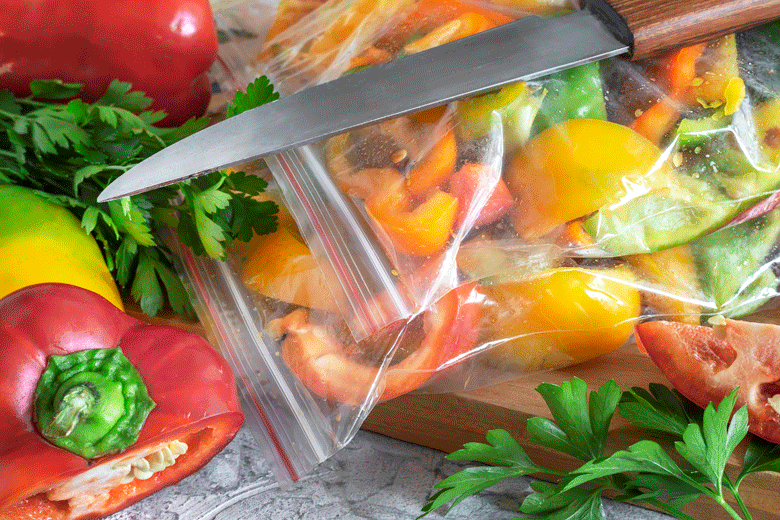
A guide to freezing Chillies

How to freeze Chillies

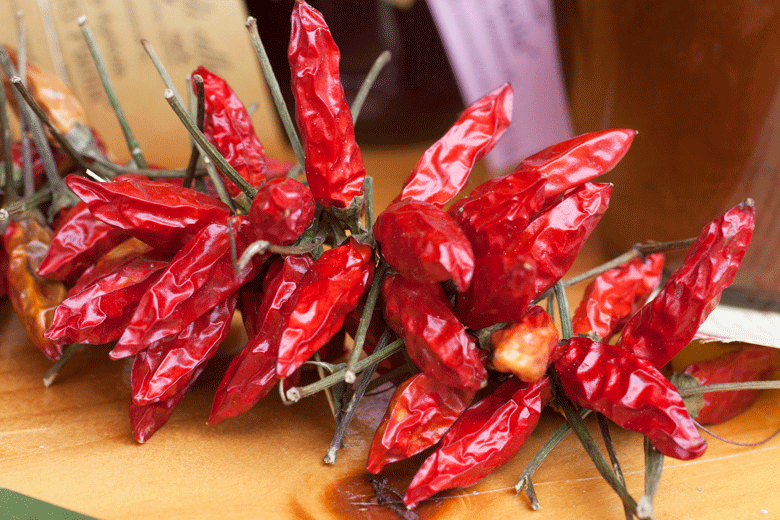
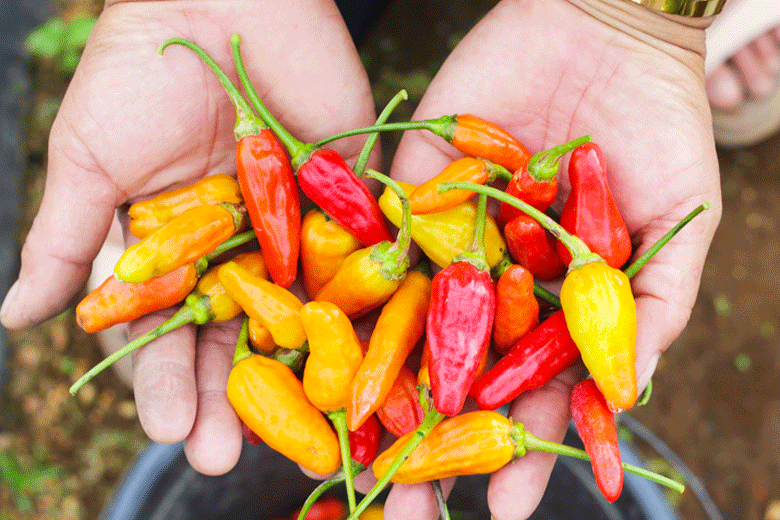
The end of the Chilli growing season for 2022 is fast approaching. If your Chillies are ripe or at least a mature green, now is the time to pick them. If you have a big harvest , besides drying Chillies, pickling them or turning them into hot sauces, relishes, jams or chutneys, a great way of preserving Chillis to freeze them.  Alternatively, it might be better to bring them in doors as if the first frost arrives. Otherwise, you will have to throw them away. They will become mushy, and they will not be able to be stored
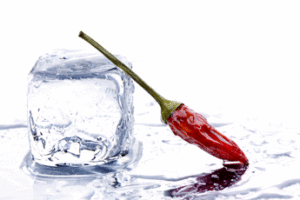
Freezing Chillies can be done in two ways. The first method is to freeze them with their stalks intact; the second is to chop them finely and place them in ice trays. When freezing in ice- trays fill the individual cavities as much as possible and then fill the cavity with a little water. Once the trays have been frozen, remove the Chilli cubes and place them in a resealable plastic bag and place them in your freezer. Then when cooking, it simply becomes a matter of removing a cube from the bag and popping it into whatever ever you are making.

When freezing them whole place the Chillies in resealable bag and remove as much air as possible before resealing the bag . Once they have  been frozen whole  they can be chopped into pieces and added  into food. They can also be grated while still frozen into any dish you are preparing.
Read more

Ripening with grow lights

Grow lights work well

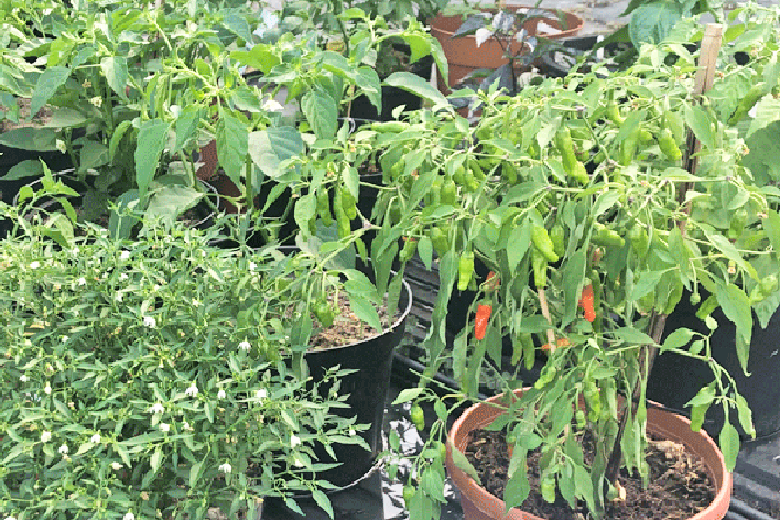
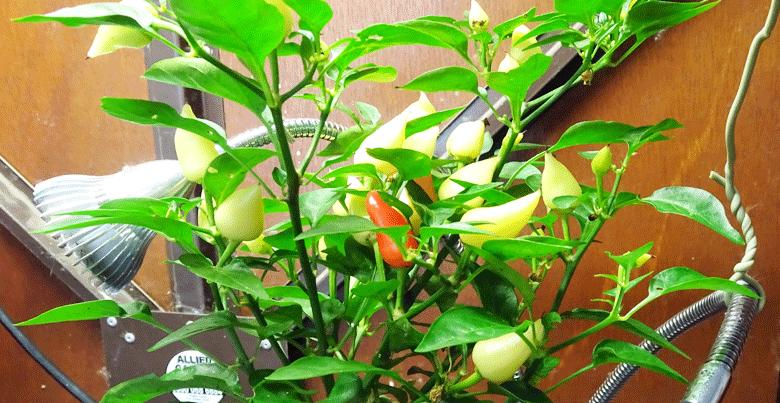
Last year September because I was experiencing a problem  with getting my Chillies ripe in time for the end of the season I placed them under grow lights to see whether this would speed up ripening . After two weeks, I was delighted to advise it had worked. The two plants I had under the lights started to ripen. Two other plants of the same variety that I had kept outside showed  no signs of doing the same. This  convinced me that ripening under grow lights works. Here is what happened.

Read more

How to save seeds

Saving seeds for next year

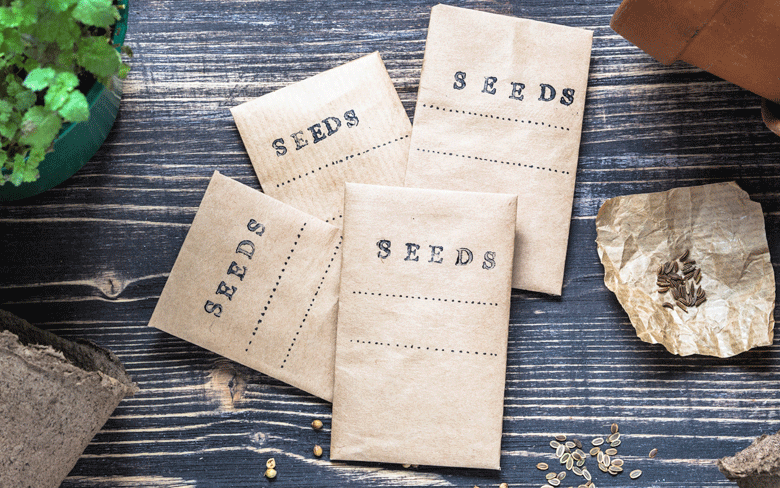
With the Chilli season coming to a close and Chilli harvesting in full swing in the United Kingdom, now is the time to start saving seeds for next season. With the hefty price that some seed suppliers charge for their seeds, this makes good financial sense. Besides, if you have plants that have done exceptionally well in the season, why not save some seeds for next year?

To successfully save seeds, choose fruit that is slightly overripe.  The chances of the seeds being fertile are far more likely if they are at this stage of ripeness. Also, make sure you only chose pods that are healthy and not showing any signs of disease.

Once you have picked them, slice them in half and scrape them out of their pods. Try to scoop out as little of the white membrane when doing this, as not doing so can cause seeds to become mouldy during drying. This can cause them to become infertile

Once the seeds have been scrapped out of their pods, place them in a tea strainer under cold running water, and gently wash away as much of the placenta as possible. If this doesn’t,  work try placing the seeds in a jar with some water, and shake them until any remaining placental tissue shakes loose from the seed.

Read more

How to dry Chillies

Drying Chillies

We are now at the stage in the season, where most of us harvest our Chillies. It is the time of year when we need to decide how we will use them.  We can make pickles, jams, relishes, Chilli oils, and Chilli sauces. Alternatively, we can preserve them either by freezing or drying

Drying Chillies is a particularly good way to preserve Chillies. This can be done in a dehydrator or alternatively in an oven.  Electric dehydrators are a particularly good way to dry Chillies. A dehydrator can be purchased relatively inexpensively online for between £50 and £60. They generally consist of a dehydrating unit, which has a fan, and multi-tier drying trays with metal or plastic mesh bases, which are used to dehydrate Chillies
To use this type of dehydrator, simply place whole Chillies in dehydrating trays on top of the dehydrator and place the lid on. Set the temperature to about sixty degrees Celsius, and turn on the dehydrator. After between eight and twelve hours, the Chillies will be dry. Remove them from the tray and pack them into airtight jars for later use.

There are more expensive dehydrators that can be used to dry Chillles. They resemble mini ovens, complete with thermostats, drying shelves and a glass door.  They are however somewhat more expensive and cost anywhere from £200 or more

Read more

How to pick Chillies

Harvest time

We are now at the point in the season where many Chilli growers harvest their crops. Many of our Chillies have now ripened. However, if you are like me, there is still a while to go until the end of the season. With this in mind, I want to harvest what I can without damaging my plants. Particularly those I want to overwinter. This is where the method  used to pick the Chillies becomes important. I cover this topic in this post

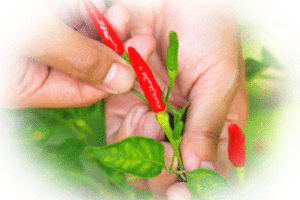
The best way to harvest Chillies is by snapping the Chillies off at the base of their calyxes with your fingers. Simply hold the base of the calyx between your thumb and index fingers, and pull the Chilli away from it using the same fingers on the other hand.

Snipping Chillies off at the stem using scissors instead of snapping them off can pose a risk to the plant. By snipping the Chilli plant on its stem with scissors, you create an “open wound” on it. There is then a possibility the stem will rot, and this may introduce disease into the plant. This is the last thing you want to happen. To keep plants over winter, they will need to be as robust as possible when beginning the overwintering process. It is the only way the plants will survive and thrive in the next season

Read more

When to harvest Chillies in the UK

When to pick Chillies in the UK

Today I made a second harvest of Chillies. I harvested some about two weeks ago, and today picked some more, for no other reason than that they were ripe, and it was the optimum time for these Chillies to be harvested. Not doing so would have meant that they would have gone past their prime. Picking them too early would have meant they would not have developed to their full potential.

There is no hard and fast rule when to harvest Chillies in the UK.  You can start at any time, provided the Chillies have  ripened. In certain Chillies, that may mean they have changed from green to red, orange, or yellow. Other varieties may start off yellow and ripen to orange, or even begin purple and then turn red. The variations of ripening are endless

The important thing to remember here is that you should only pick Chillies when they are nearly fully ripe. Unlike tomatoes, Chillies will not ripen much more once they have been harvested .You can of course pick them when they are still green, but don’t expect them to be as hot as ripe Chillies

Luckily, many of my Chillies have started ripening, but there is a long way to go yet. Many still need to. Some are still yellow, and others are green. This means that between now and the end of November, when the first frost will arrive in the West Midlands (where we live), I need a lot more ripening to harvest while they are still outdoors.

The ripening of my Chillies this year has been a lot better than last year. This has mainly been because we had a hot summer. The Chillies grew quickly, which in turn means they can ripen more quickly. Hopefully this will happen. However in the UK, because of the short growing season, there is always a dash to get Chillies ripened before the first frost

Read more

Chillies and heat waves

Stuck in France

Sometimes when growing Chillies, the strangest things happen. And that is exactly what happened to me this season.   My Chilli growing season was following a normal pattern, and then disaster struck. Half my Chillies died. This wasn’t due to any mistakes I made, but rather due to what life throws at you.  Let me explain.

When my wife and I went to Bordeaux in France for her birthday, we had no idea what was waiting for us.  We had gone to the region to visit wine estates when a we were hit by the unexpected.  What was supposed to be a relaxing one-week holiday, eating fine French cuisine and drinking good wine in sunny France, turned into a nightmare. We caught COVID-19.

In France, the regulations dictate that when you get Corona virus disease, you must mandatorily self-isolate for seven days. In our case, it struck down my wife first. Three days later, I too became infected.  That was it. It meant we were stuck in the country. We had no choice but to follow the rules. A holiday that was only supposed to have taken a week landed up with us being holed up in a hotel room for ten days, with reception and room service being our only connection to the outside world.

Before leaving for France, had I known that we were going to be away for so long, I would have been more careful to ensure my plants had more than enough water to survive longer. Particularly because I knew that the United Kingdom was in the throes of a heat wave. Temperatures were predicted to be well over 30 degrees Celsius for the period. Unfortunately, I didn’t. There was no way to predict what would happen.

Read more

The Dr Trouble Chilli sauce story

In search of adventure

Upon his arrival in Africa during the late 19th century, Robert Alexander Fletcher, a Scottish cartographer seeking adventure, unknowingly laid the foundation for one of Africa’s premier chilli sauces. The genesis of Dr Trouble Chilli sauces can be traced back to Fletcher’s experiences in Zimbabwe and the unique journey that unfolded.

Initially employed by the infamous British colonialist Cecil John Rhodes, Fletcher embarked on a mission to map the territories colonized by Rhodes, collectively known as Rhodesia. Armed with just a rifle, salt, and a flint, he and his assistant traversed the African bushveld on horseback, relying on their hunting skills to procure sustenance from the wild. Survival also meant depending on the numerous streams and rivers for water.
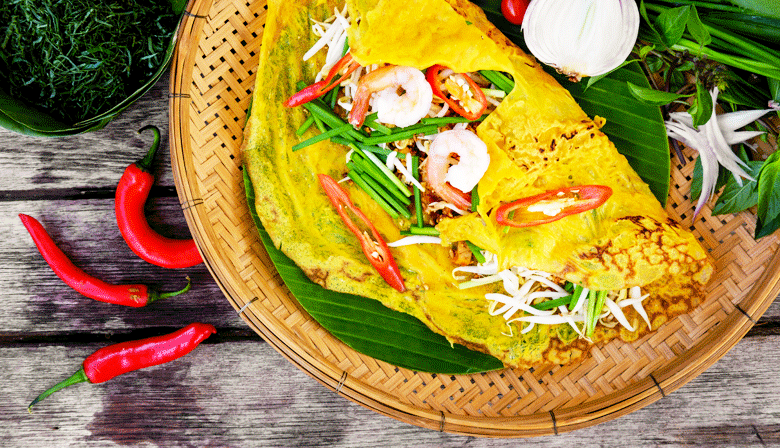
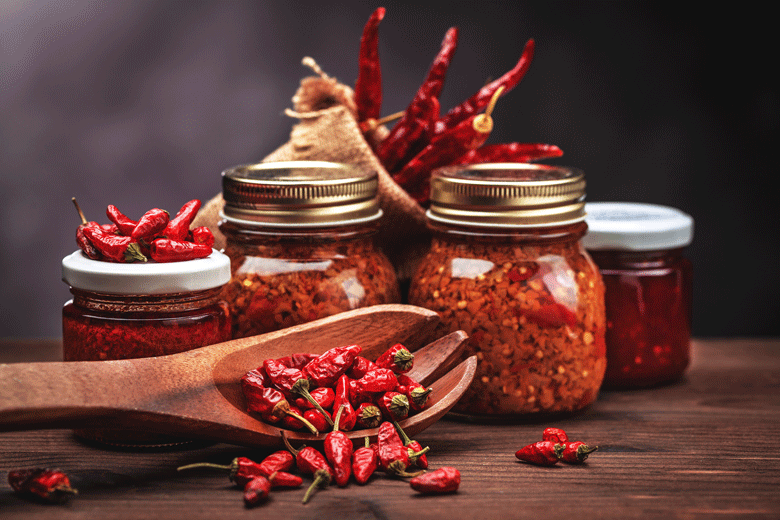

During his extensive travels, Fletcher received a gift of chillies from an African tribal leader. These chillies, likely of the African Birds-eye variety, may have reached the region through trade with Arab or Portuguese merchants. Fletcher, envisioning possibilities, retained some of these chillies as seeds. It’s plausible that, in the heart of the African wilderness, he experimented with combining these chillies with wild lemons and salt to enhance the flavour of the meats grilled over open fires.

Upon returning home, Fletcher cultivated the seeds and delved into refining the knowledge acquired in the bushveld. His experimentation led to a meticulous process, including sun fermentation, resulting in a chili sauce that satisfied his discerning palate. The rudimentary recipe for this unique concoction was recorded on the back of a notebook, marking the genesis of the renowned Dr Trouble Chili sauces. It was the start of bigger and better things to come

Read more

The use of Chillies in Thai cooking

The History Of Chillies in Thailand

Whilst it is not entirely clear how the Chilli arrived in Thailand, it is speculated that it arrived there via the Portuguese.  Ceylon (modern-day Sri Lanka), which is relatively close to Thailand, was occupied by the Portuguese from 1505 to 1658.  When considering that wherever the Portuguese went, their Chillies went with them. As  Sri Lanka likes extremely pungent foods, it is not unlikely that the Chilli was introduced to the island during this time. In turn, they would have found their way via trade or the flight of birds (who absolutely love Chillies) carrying seed to Thailand.

Read More

History of hot sauce in the UK – Part 2

A soldier’s best friend

In my previous post on this subject, I mentioned that members of the Armed Forces are great fans of hot sauces. So much so, they even take them on twenty-four-hour combat missions as a standard part of their operational ration packs.

If hot sauces are so important that soldiers take them into combat, just imagine where else they are used.  Hot sauce goes on everything from the eggy, cheesy, hammy, bread on submarines to the breakfast fried eggs in an army mess hall. It is almost certainly used in the cuisine enjoyed by officers. Hot sauce is a soldier’s best friend

Where it is easy to find hot sauces back in the United Kingdom nowadays, but this was not always the case. Often when soldiers returned from overseas tours of duty, they would soon discover  the hot sauces they had come to love in other parts of the world were hard to find. It wasn’t that they couldn’t get their hands on Tabasco® or Lingham’s Chilli sauce (see note).  These sauces had already been in the UK for a long time, and were already national favourites. It was more a matter of trying to find the types of sauces they had enjoyed overseas. These sauces were far different to the ones  back home.

It is likely the only way to get around this was to grow Chillies and make their own hot sauces. However, this solution was not that easy to achieve. Seeds for Chillies were not that easy to find, and not all soldiers were gardeners (or cooks for that matter).  Sadly, this meant they had to go without their favourite sauce. It was a crazy situation, you needed hot sauce, but couldn’t buy it for love nor money.

Read more