
How to overwinter Chillies

The first frost

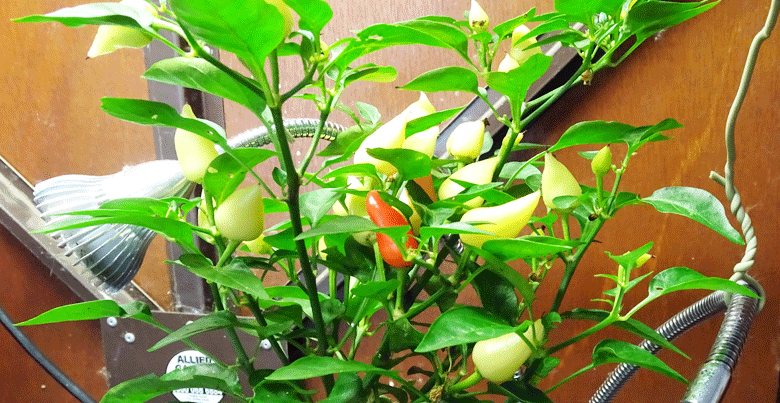
The first frost has arrived in the West Midlands. With the anticipation that it would arrive around about now, three weeks ago I brought most of my Chillies in doors. Most are in my garage under grow lights as many still must ripen fully. I also prepared a couple of my larger plants for overwintering and even turned one of my larger plants (a Fatalii) into a Bonchi. Bonchi’s are Chilli plants that have been cut in such a way that they will eventfully resemble Bonsai trees. They make great indoor ornamental plants

Overwintering Chillies is done by removing most of their foliage and pruning their stems so that the plant is placed in a position that it requires very  little nutrition to grow. It means that when the plant goes into dormancy for the winter it can stay sufficiently alive to survive the winter. When spring arrives, the plant will then break out of dormancy and have a head start in in producing Chillies in the next season.

In their natural environment (hotter climates) Chillies are perennials. Perennials are plants that do not completely die off during winter in the same way annuals do. They lose foliage and stop growing during winter but will spring back into life at the onset of summer. In the UK, however, because of the cold winters, this is not possible. Chillies cannot survive freezing and die if exposed to  the zero-degree temperatures that are often experienced in the United Kingdom during this time of the year.

Read more

A guide to freezing Chillies

How to freeze Chillies

The end of the Chilli growing season for 2022 is fast approaching. If your Chillies are ripe or at least a mature green, now is the time to pick them. If you have a big harvest , besides drying Chillies, pickling them or turning them into hot sauces, relishes, jams or chutneys, a great way of preserving Chillis to freeze them.  Alternatively, it might be better to bring them in doors as if the first frost arrives. Otherwise, you will have to throw them away. They will become mushy, and they will not be able to be stored

Freezing Chillies can be done in two ways. The first method is to freeze them with their stalks intact; the second is to chop them finely and place them in ice trays. When freezing in ice- trays fill the individual cavities as much as possible and then fill the cavity with a little water. Once the trays have been frozen, remove the Chilli cubes and place them in a resealable plastic bag and place them in your freezer. Then when cooking, it simply becomes a matter of removing a cube from the bag and popping it into whatever ever you are making.

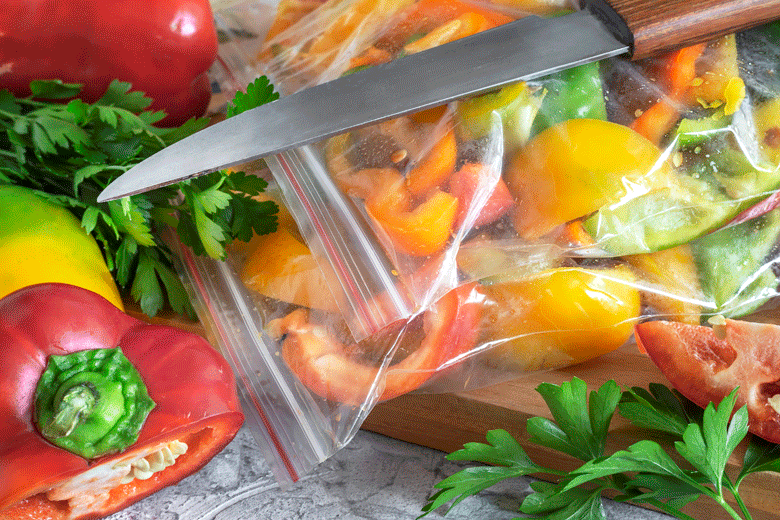
When freezing them whole place the Chillies in resealable bag and remove as much air as possible before resealing the bag . Once they have  been frozen whole  they can be chopped into pieces and added  into food. They can also be grated while still frozen into any dish you are preparing.

Read more

Ripening with grow lights

Grow lights work well

Last year September because I was experiencing a problem  with getting my Chillies ripe in time for the end of the season I placed them under grow lights to see whether this would speed up ripening . After two weeks, I was delighted to advise it had worked. The two plants I had under the lights started to ripen. Two other plants of the same variety that I had kept outside showed  no signs of doing the same. This  convinced me that ripening under grow lights works. Here is what happened.

Read more

How to save seeds

Saving seeds for next year

With the Chilli season coming to a close and Chilli harvesting in full swing in the United Kingdom, now is the time to start saving seeds for next season. With the hefty price that some seed suppliers charge for their seeds, this makes good financial sense. Besides, if you have plants that have done exceptionally well in the season, why not save some seeds for next year?

To successfully save seeds, choose fruit that is slightly overripe.  The chances of the seeds being fertile are far more likely if they are at this stage of ripeness. Also, make sure you only chose pods that are healthy and not showing any signs of disease.

Once you have picked them, slice them in half and scrape them out of their pods. Try to scoop out as little of the white membrane when doing this, as not doing so can cause seeds to become mouldy during drying. This can cause them to become infertile

Once the seeds have been scrapped out of their pods, place them in a tea strainer under cold running water, and gently wash away as much of the placenta as possible. If this doesn’t,  work try placing the seeds in a jar with some water, and shake them until any remaining placental tissue shakes loose from the seed.

Read more